
 English English
 Views: 0 Author: Site Editor Publish Time: 2026-09-02 Origin: Site


Procuring substandard facade access equipment carries severe operational and financial stakes. A single mechanical failure can lead to catastrophic safety incidents, fatal accidents, crippling project delays, and massive compliance fines. The global market is saturated with white-labeled equipment and vendors claiming to be original manufacturers. Procurement teams struggle to differentiate between genuine engineering firms with rigorous quality control and high-risk assemblers competing solely on price. This guide introduces a systematic, evidence-based framework for vetting a suspended platform manufacturer. We will cover how to evaluate mechanical construction, verify safety compliance, match specific platform configurations to project scopes, and assess long-term vendor reliability.
Verify, Don't Trust: Prioritize manufacturers that provide transparent, verifiable third-party testing reports and compliance certificates (OSHA, CE, EN 1808) over those relying on marketing claims.
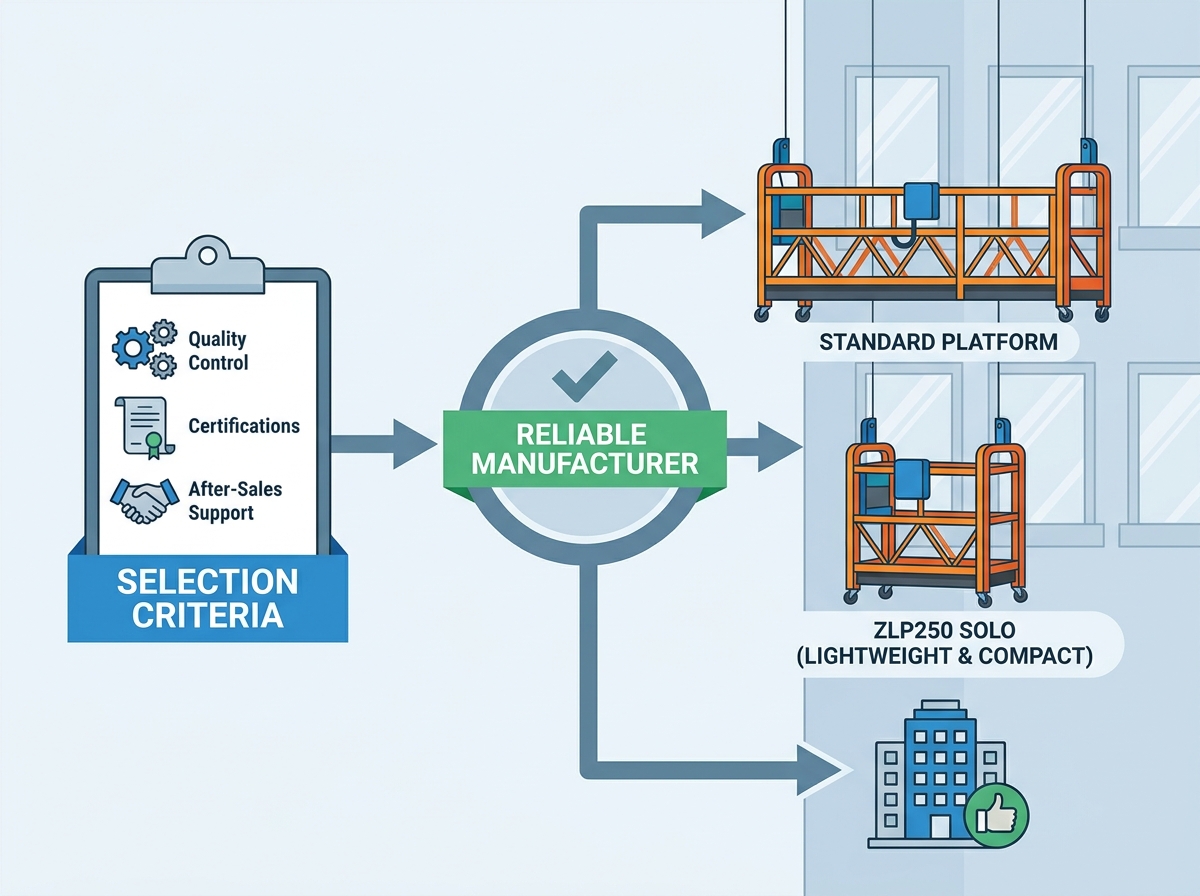
Match Specs to Site Reality: Ensure the manufacturer offers a diverse portfolio—from heavy-duty multi-point systems to a ZLP250 solo suspended platform—to align exactly with specific facade complexities and load requirements.
Audit the Supply Chain: A reliable suspended platform manufacturer controls the quality of critical components (hoists, safety locks, electrical panels) rather than outsourcing to unverified third parties.
Before contacting suppliers, define your operational parameters. Calculate the maximum building height, identify roof rigging constraints, and map the specific size and shape of the construction area. You must establish strict Safe Working Load (SWL) requirements. Differentiate between personnel weight, tools, and heavy construction materials to ensure the platform capacity is never exceeded during operations. Site constraints dictate the exact type of rigging mechanism you can deploy. Parapet clamps work well for strong, reinforced concrete parapets. Suspension mechanisms with counterweights are necessary for flat roofs without structural tie-off points. You need to measure the outreach distance from the roof edge to the facade surface. This measurement determines the length of the front beam on your suspension mechanism. If the outreach is too long, the counterweight requirement increases exponentially, which might exceed the roof's structural load limit.
Consider the environmental conditions at the job site. High wind zones require specialized stabilization systems, such as wire rope lanyards or suction cups attached to the facade. Coastal environments demand high-grade anti-corrosion treatments on all metal components. You must evaluate the power supply available on site. Most commercial platforms run on 3-phase 380V or 415V power, but some sites only offer single-phase 220V. Matching the motor specifications to your site's electrical infrastructure prevents costly electrical modifications later.
Load Category | Description | Typical Weight Allowance |
|---|---|---|
Personnel Load | Weight of operators wearing full safety gear and harnesses. | 80 kg to 100 kg per person |
Tool Load | Hand tools, power tools, and immediate consumables. | 20 kg to 50 kg total |
Material Load | Glass panels, cladding materials, mortar, or heavy replacement parts. | Varies heavily (100 kg to 500+ kg) |
Dynamic Load Factor | Additional stress applied during hoist startup, stopping, or wind gusts. | Calculated at 1.25x to 1.5x static load |
Mechanical downtime directly impacts project timelines. When a hoist fails or a safety lock jams, work stops immediately. Examine the legal and financial liabilities associated with safety mechanism failures and non-compliant equipment. Investing in reliable machinery prevents costly delays and protects your workforce from severe hazards. A snapped wire rope or a failed traction motor triggers immediate site shutdowns by safety inspectors. These shutdowns last until a full investigation concludes, which can take weeks. You still pay labor costs for idle workers during this period. Crane rentals, street closure permits, and scaffolding alternatives add massive unexpected expenses to your budget.
Substandard equipment often suffers from electrical faults in the control box. Cheap contactors weld shut under heavy loads, causing the platform to move uncontrollably. Poorly sealed electrical panels allow moisture ingress, leading to short circuits and electrocution risks. You must verify that the manufacturer uses internationally recognized electrical components, such as Schneider or Siemens, rather than unbranded alternatives. The initial savings on a cheap platform evaporate the moment a critical component fails on a high-profile job site.
Different facades require different structural configurations. Two-point systems handle standard linear facades, providing a stable working area for multiple operators. Multi-point systems suit heavy-duty applications or exceptionally wide operational areas. Evaluate the manufacturer's engineering capability to provide modular standard platforms, such as ZLP630 or ZLP800, alongside custom corner sections for complex architectural designs. A standard two-point suspended platform typically ranges from 2 meters to 6 meters in length. You assemble these from modular 1-meter or 2-meter sections. This modularity allows you to adjust the platform length based on the specific drop location on the building.
Multi-point systems are necessary when handling massive glass panels or heavy stone cladding. These systems utilize three or more hoists to distribute the load evenly across the platform structure. They require complex synchronization controls in the electrical box to ensure all hoists lift and lower at the exact same speed. If one hoist lags, the platform tilts, triggering the safety locks and halting operation. You must ensure the manufacturer has proven experience engineering these synchronized control systems.
Assess the total length of the facade drop to determine modular section requirements.
Calculate the combined weight of operators and materials to select the appropriate hoist capacity (e.g., 6.3kN vs 8.0kN).
Determine if the building corners require 90-degree, 45-degree, or custom-angled platform sections.
Verify the synchronization capabilities of the electrical control box for multi-point setups.
For single-point, single-operator tasks, specific equipment is necessary. Localized facade inspection, window cleaning, or minor localized repairs often require a specialized approach. Deploying a compact suspended platform offers significant operational advantages in tight urban footprints with limited roof space or restricted rigging access. A standard 6-meter platform is overkill for replacing a single broken window on the 40th floor. It requires massive counterweights and multiple operators to rig safely. A ZLP250 solo suspended platform solves this problem. It utilizes a single traction hoist and a single safety lock, suspended from a simplified rigging mechanism.
This compact design allows a single worker to transport the entire system in a standard service elevator. You can rig it on narrow balconies, tight roof corners, or inside industrial shafts where traditional platforms cannot fit. The solo platform features a specialized L-shaped or U-shaped stirrup to maintain balance and stability around the single suspension point. You must verify that the manufacturer includes an anti-spin mechanism, usually a secondary wire rope or a facade roller, to prevent the basket from rotating in the wind.
Material selection impacts both durability and handling. Specify a lightweight suspended platform made of aluminum to reduce roof load, resist environmental corrosion, and improve manual handling during installation. Contrast this with galvanized steel, which is necessary for heavy-duty construction environments requiring maximum durability against physical impact and abrasive materials. Aluminum platforms cost more upfront but save massive amounts of labor time during assembly and dismantling. A 2-meter aluminum section weighs significantly less than its steel counterpart, allowing two workers to carry it easily across a crowded roof.
Galvanized steel platforms withstand brutal abuse on masonry or concrete repair sites. Dropped tools, swinging debris, and abrasive mortar will quickly dent and gouge aluminum. Hot-dip galvanized steel resists this physical damage while providing excellent rust protection. You must check the thickness of the zinc coating on steel platforms. A thin electro-galvanized coating will rust within months on a coastal job site. Demand hot-dip galvanizing with a minimum coating thickness of 65 microns for long-term durability.
Feature | Aluminum Alloy Platform | Hot-Dip Galvanized Steel Platform |
|---|---|---|
Weight | Approximately 30-40% lighter than steel. | Heavy, requires more effort to transport and assemble. |
Corrosion Resistance | Excellent natural resistance, ideal for coastal areas. | High resistance, but scratches can expose bare steel to rust. |
Impact Durability | Moderate. Can dent under heavy impact. | Excellent. Withstands harsh construction environments. |
Handling & Assembly | Fast and easy manual handling by fewer workers. | Slower assembly, often requires mechanical lifting aids. |
Inspect the structural integrity of the equipment. Look for high-quality weld penetration, strict material thickness tolerances, and top-grade anti-corrosion treatments. Evaluate the engineering of the traction hoist mechanism and verify the specifications of the galvanized steel wire ropes to ensure maximum component durability under heavy loads. The traction hoist is the heart of the system. It uses an "alpha" or "S" type rope threading mechanism to grip the wire rope. You must ask the manufacturer about the material used for the internal rope guide and the driving sheave. These components endure immense friction. High-quality hoists use nitrided steel or specialized alloys for the driving sheave to prevent premature wear.
Examine the welding on the platform stirrups and suspension jibs. Robotic welding provides consistent, flawless seams, whereas manual welding can leave slag inclusions or undercut edges that weaken the structure. Ask for the material test reports (MTRs) for the raw steel or aluminum used in the fabrication. The wire ropes must be specifically designed for traction hoists, typically featuring a 4x31 or 4x25 construction with a steel core. Standard crane ropes will flatten inside the hoist mechanism, causing catastrophic jamming.
Verify the internal components of the traction hoist are made from wear-resistant alloys.
Check for robotic welding on critical load-bearing structures like stirrups and suspension beams.
Ensure the wire ropes are specifically rated for traction hoist applications, not general lifting.
Confirm the thickness of the hot-dip galvanized coating meets international standards.
Inspect the design of the counterweight system for secure locking mechanisms.
Safety systems must include redundancy. Mandate the presence of independent, secondary safety locks for anti-tilt and overspeed detection. Review electrical safety features carefully. Ensure the equipment includes overload sensors, emergency stop buttons, phase sequence protection, and manual descent capabilities during power failures. The safety lock operates on a completely separate wire rope from the traction hoist. If the main hoist rope snaps, or if the platform tilts beyond a specific angle (usually 3 to 8 degrees), the safety lock mechanically clamps onto the secondary rope within centimeters. You must verify that these locks are dynamically tested at the factory.
Electrical redundancy is equally important. The control box must feature phase sequence protection. If the site generator is wired incorrectly, the motors could run in reverse, causing the platform to drive up when the operator presses down. Phase protection prevents the system from operating until the wiring is corrected. Overload sensors prevent the hoists from lifting if the platform exceeds its rated capacity. This stops operators from overloading the basket with too much material, which is a common cause of rigging failure.
Require non-negotiable international standards such as CE marking, UL listing, ISO 9001, and EN 1808. Procurement teams must learn how to spot forged, expired, or irrelevant compliance documentation. Always request the original certificates and verify them directly with the issuing certification body. Many low-end assemblers provide "CE certificates" issued by unaccredited third-party brokers. These documents hold no legal weight. A genuine CE certificate for a suspended access system must reference the EN 1808 standard and be issued by a recognized Notified Body.
Check the scope of the ISO 9001 certificate. It should explicitly state "design and manufacture of suspended access equipment." If it only says "sales" or "export," you are dealing with a trading company, not a manufacturer. Request the type-test reports that back up the certifications. These reports detail the exact dynamic load tests, drop tests, and electrical insulation tests performed on the equipment. A legitimate manufacturer will provide these reports without hesitation.
Vendors who merely assemble outsourced parts present significant quality control risks compared to true manufacturers with in-house machining and fabrication. Request virtual or physical factory audits. Demand documented dynamic and static load test reports for every batch before shipment. An assembler buys hoists from one factory, safety locks from another, and metal baskets from a third. They bolt them together and slap a sticker on the control box. When a component fails, the assembler blames their sub-supplier, leaving you without support or replacement parts.
A true manufacturer machines their own hoist casings, cuts their own gears, and fabricates their own platform structures. This vertical integration guarantees strict quality control across the entire system. During a factory audit, look for CNC machining centers, robotic welding stations, and dedicated testing towers. A manufacturer should have a testing tower at least 10 meters high to perform dynamic drop tests on their safety locks. If they lack a testing tower, they cannot guarantee the reliability of their safety mechanisms.
Investigate the origin of high-wear and high-risk components, including motors, gearboxes, and contactors in the electrical control box. Assess the manufacturer's research and development investment aimed at improving component lifespan and overall system durability. Even true manufacturers outsource certain standard components, like electric motors and contactors. You need to know exactly whose components are inside the machine. A high-quality hoist uses a motor from a reputable brand with a proven track record in heavy-duty lifting. The gearbox should use high-grade synthetic oil and feature precision-cut gears to minimize noise and vibration.
Open the electrical control box during your evaluation. Look for neatly organized wiring, clear terminal labels, and branded contactors (e.g., Schneider, ABB). Messy wiring and unbranded electrical parts indicate a manufacturer cutting corners to lower costs. Ask about the R&D department. Are they actively developing new safety features, such as wireless overload monitoring or automated leveling systems? A manufacturer investing in R&D is committed to long-term product improvement, not just short-term sales.
Evaluate whether the manufacturer provides comprehensive installation manuals, video tutorials, or on-site commissioning and training programs. Formal operator certification programs provided by the manufacturer ensure compliance with local labor and safety laws. Relying solely on third-party contractors for initial setup without manufacturer guidance introduces significant risk. Rigging a suspension mechanism requires precise calculations regarding counterweights and outreach distances. If the rigging crew miscalculates, the entire system can pull off the roof.
The manufacturer must supply detailed rigging charts that clearly state the required counterweight for every possible outreach configuration. They should offer video tutorials demonstrating the correct procedure for threading the wire ropes through the hoist and safety lock. Incorrect threading causes the rope to jam and shear inside the mechanism. For large projects, demand that the manufacturer sends a technical engineer to the site for initial commissioning. This engineer will verify the rigging, test the safety systems, and train your lead operators on emergency descent procedures.
Mitigate project downtime by assessing the manufacturer's global or regional distribution network. Ensure guaranteed availability of proprietary replacement parts, such as hoist components and safety locks, for the projected lifespan of the equipment. Hoist motors burn out, contactors fail, and wire ropes wear down. You will need spare parts. If the manufacturer is located overseas and has no local distribution network, you might wait weeks for a replacement gear or safety lock. This delay halts your entire project.
Ask the manufacturer for a recommended spare parts list for a 12-month operational period. This list should include items like wire rope guides, brake rectifiers, contactors, and limit switches. Purchase this spare parts package alongside the initial equipment order. Keep these parts in your site storage container. When a minor component fails, your site mechanic can replace it immediately, minimizing downtime. Verify that the manufacturer guarantees part compatibility for at least 10 years. You do not want to scrap a perfectly good platform because a specific hoist gear is no longer in production.
In the procurement of suspended access equipment, verifiable safety engineering, strict Safe Working Load adherence, and manufacturer transparency must completely override initial cost savings. Filter candidates by demanding proof of certification, matching their product range to your specific portfolio needs, and auditing their supply chain.
Request detailed technical specification sheets for all hoists, safety locks, and structural components.
Demand unredacted third-party testing reports and verify them directly with the issuing Notified Body.
Schedule a comprehensive technical interview or a live video factory audit with the shortlisted vendors.
Order a recommended 12-month spare parts package alongside your initial equipment purchase to prevent future downtime.
A: Request the original certificate documents and check the certification body's official database. Contact the issuing agency directly with the certificate number to confirm its current validity and scope. Ensure the certificate references the correct standards, such as EN 1808.
A: With rigorous daily inspections and scheduled maintenance, high-quality platforms typically last 10 to 15 years. Component lifespans vary; wire ropes and hoists require more frequent replacement based on usage hours and environmental conditions.
A: Single-point platforms use one hoist for solo tasks. Two-point platforms use two hoists for standard linear facades. Multi-point platforms utilize multiple hoists to support heavy loads or complex, wide architectural shapes, requiring synchronized electrical controls.
A: Choose a solo platform for localized tasks like window cleaning, minor repairs, or inspections where roof space is limited, rigging access is restricted, and only one operator is required. It is easier to transport and rig.
A: Lightweight platforms, usually made of aluminum, offer a higher payload-to-weight ratio. They reduce the dead load on roof rigging structures while maintaining sufficient capacity for personnel and standard tools, making manual assembly much faster.
A: Inspect safety locks and hoists daily before use. Perform comprehensive professional maintenance annually. Replace components strictly according to the manufacturer's specified operational hour limits or immediately if wear, corrosion, or damage is detected.


