
 English English
 Views: 0 Author: Site Editor Publish Time: 2026-08-19 Origin: Site


High-altitude facade access and exterior construction require equipment where mechanical failure is not an option. Procurement teams and project managers often evaluate access equipment based on surface-level specifications, neglecting the mechanical realities of hoist systems, safety locks, and material durability. This oversight leads to compliance failures, unexpected downtime, and severe safety liabilities on the job site. You need to understand the underlying engineering to ensure operational safety and project efficiency. This guide deconstructs the structural mechanics of a suspended platform, explaining exactly how the core components operate under heavy load. By understanding these mechanics, buyers can accurately evaluate technical specifications, assess equipment longevity, and confidently select the right setup for their specific site requirements. We will break down the rigging, traction hoists, and safety mechanisms so you know exactly what to look for before deploying equipment hundreds of feet in the air.
Mechanical Synergy: A safe suspended platform relies on the precise interaction between the roof suspension mechanism, traction hoists, and independent safety locks.
Industry Standards: The ZLP series suspended platform (specifically ZLP630 and ZLP800) operates as the global baseline for modular, high-altitude access due to its standardized hoist and safety lock mechanisms.
Safety Redundancy: True operational safety is dictated by dual-wire rope systems (working and safety ropes), centrifugal or swing-arm safety locks, and strict adherence to environmental operational limits.
Supplier Due Diligence: Evaluating a suspended platform supplier requires looking beyond the initial quote to assess component sourcing (motors, steel/aluminum quality), ISO/CE certifications, and post-sale technical support.
To evaluate the reliability of a platform, buyers must first understand how the system distributes weight and achieves vertical mobility without compromising stability. A robust system relies on precise engineering across its suspension, basket, and hoist components. You cannot afford to guess how these parts interact when lives are on the line.
The roof suspension mechanism provides the structural anchor for the entire system. It consists of jibs, front and rear supports, and tension wire ropes. The physics rely on calculating the overturning moment against the stabilizing moment. Counterweights placed on the rear support must provide enough mass to ensure absolute structural balance, preventing the rig from tipping under maximum load. You have to calculate the exact overhang distance and match it with the correct counterweight ratio.
Implementation realities heavily influence the setup. Parapet walls, roof load limits, overhang distances, and roof surface protection dictate the configuration of the suspension beams. If a building has weak roofing materials, load distribution plates become necessary to prevent structural damage while maintaining rigging stability. I have seen poorly distributed loads crack roof membranes, causing massive water damage and project delays.
Measure the parapet height to ensure the front support clears the edge safely.
Calculate the maximum outreach required to access recessed facade elements.
Verify the roof's structural load capacity with the building engineer.
Place heavy-duty rubber mats under the support bases to protect the roof membrane.
Secure all counterweights with locking pins so they cannot be removed unauthorized.
The working basket is a modular assembly comprising balustrades, bottom plates, and mounting frames. This modularity allows crews to adjust the platform length based on specific facade requirements. When evaluating a standard suspended platform, material choice is a primary consideration. You need to match the material to the environment and the payload.
Aluminum alloy baskets offer excellent corrosion resistance and lighter deadweight, which makes manual handling easier on site. Hot-dip galvanized steel baskets provide superior structural rigidity and withstand harsh impacts better, though they are heavier. Modularity impacts site logistics significantly. A well-designed system reduces assembly time and allows scalability across different building facades, including the ability to configure L-shaped or curved platforms for complex architecture.
Material Type | Weight Profile | Corrosion Resistance | Best Application |
|---|---|---|---|
Aluminum Alloy | Lightweight | Excellent | Coastal areas, frequent relocations |
Galvanized Steel | Heavy | Good | Heavy masonry, demolition work |
Painted Steel | Heavy | Poor | Short-term, dry environment projects |
The traction hoist functions as the engine of the platform. It typically utilizes an "a" or "s" type rope routing system. An electromagnetic brake motor drives the sheave, which grips the wire rope tightly to enable smooth ascent and descent. The friction generated between the sheave and the rope must be precisely calibrated to prevent slipping while avoiding excessive rope wear. If the sheave is machined poorly, it will chew through wire ropes in weeks.
When evaluating hoists, motor quality, braking torque, and gear precision are vital. High-quality internal components directly impact operational lifespan, reduce maintenance frequency, and prevent dangerous mid-air jamming scenarios. Cheaply manufactured gears wear down quickly, leading to jerky movements and potential mechanical failure. Always inspect the gear housing for oil leaks before every shift.
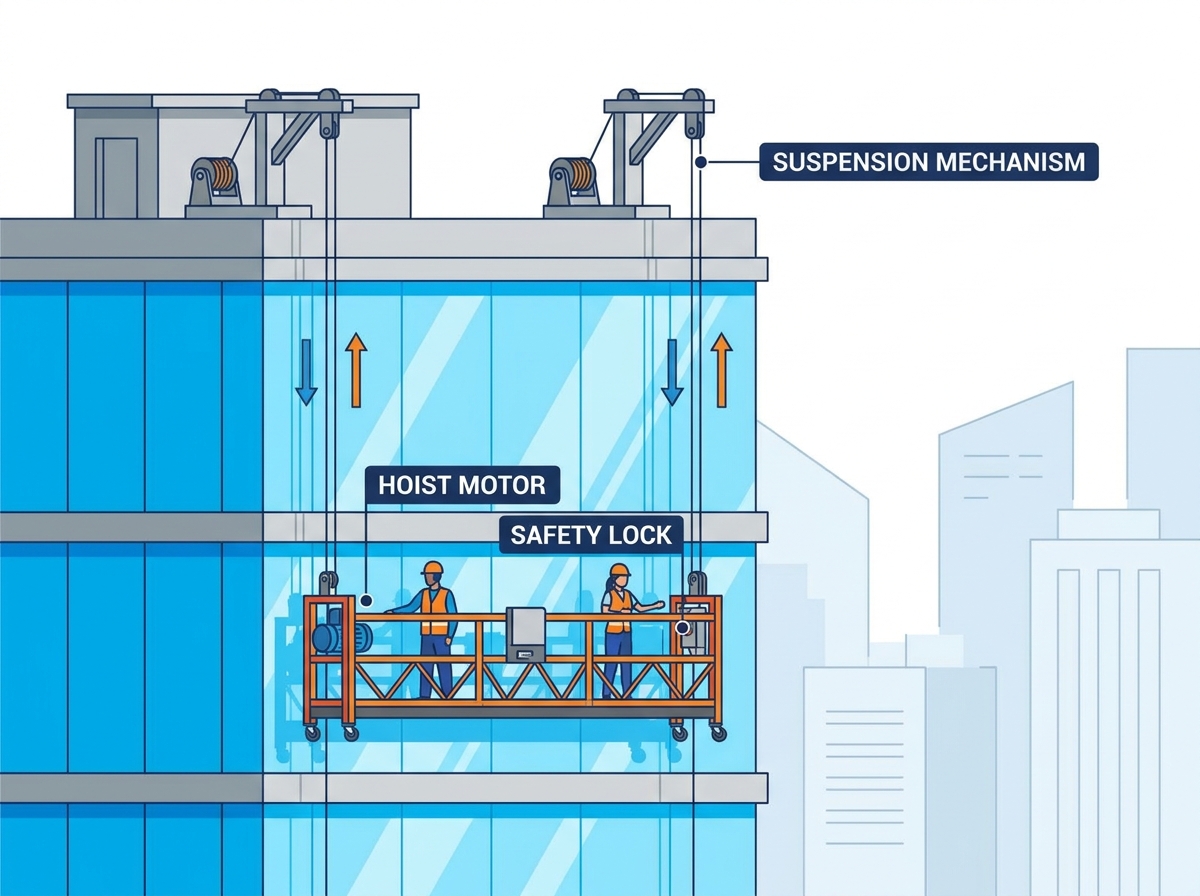
Modern platforms feature engineered fail-safes that protect against mechanical failure, operator error, or sudden environmental shifts. These systems ensure that a single point of failure does not result in a catastrophic event. You must test these systems daily.
Safety locks are independent mechanisms designed to arrest a fall instantly. The swing-arm, or anti-tilt, safety lock detects platform inclination. If the basket tilts beyond a specific angle, typically between 3 and 8 degrees, the lock instantly clamps onto the safety wire rope, halting movement. This prevents the platform from tipping over if one hoist fails or moves faster than the other. I always test the anti-tilt function by manually lowering one side of the basket a few inches above the ground.
The centrifugal safety lock is speed-triggered. It engages when the descent speed exceeds a safe threshold, usually around 30 meters per minute. Matching the correct safety lock type to the specific operational environment and platform length ensures rapid response during an emergency. Long platforms almost always require anti-tilt locks due to the higher risk of uneven loading.
These systems use specialized galvanized steel wire ropes, typically constructed as 4x31SW+FC or 6x19W+IWS. These configurations provide high tensile strength and flexibility. A critical safety standard is the physical separation between the working wire rope and the safety wire rope. Never run both ropes through the same guide channel.
The hoist climbs the working rope, while the safety lock monitors the safety rope. If the working rope snaps, the safety lock immediately grips the safety rope, suspending the platform securely. Both ropes must undergo regular inspection for fraying, kinking, or corrosion. If you see a bird-cage defect, replace the rope immediately.
Inspect ropes daily for broken wires or severe abrasion.
Lubricate ropes according to manufacturer specifications to prevent internal rust.
Ensure the rope end is properly brazed to prevent unravelling during hoist insertion.
Keep the safety rope completely free of tension during normal operation.
The electrical control panel manages power distribution and motor synchronization. Core components include contactors, thermal relays, and phase sequence relays. These elements protect the motors from voltage spikes and overheating. A blown contactor will leave your crew stranded, so keep spares on site.
Essential safety features integrated into the control system include emergency stop buttons and upper limit switches that prevent the platform from crashing into the roof rigging. In the event of a power outage, operators can use manual descent capabilities, utilizing a gravity-fed release mechanism to lower the basket safely to the ground. Train every crew member on how to use the manual release lever.
Electrical panels require strict weatherproofing standards, typically IP55 or higher, to prevent water ingress and short circuits. Integrating wind sensors provides real-time data to operators, ensuring they do not exceed safe working conditions. Water in the control box is a common cause of erratic hoist behavior.
Platforms must be grounded during high winds, typically exceeding 10.8 meters per second, heavy rain, or lightning storms. Operating outside these thresholds compromises stability and exposes the crew to severe risks. Site managers must factor these environmental limits into project timelines. Do not push your luck with incoming storm fronts.
The ZLP designation serves as the benchmark for procurement in the facade access industry. Understanding how to differentiate between models ensures you select equipment tailored to your specific project demands. You need to know exactly what capacity your job requires.
The term "ZLP" stands for temporarily installed suspended access equipment. The ZLP series suspended platform aligns with stringent international safety standards, including EN1808 and OSHA regulations. This standardization guarantees a baseline of quality and safety across different job sites.
The interoperability of parts across standard ZLP models simplifies maintenance and repairs. Predictability of performance allows project managers to plan logistics and crew deployments with confidence, knowing the equipment will function reliably under specified loads. If a hoist goes down, you can easily source a compatible replacement.
The two most common models are the ZLP630 and the ZLP800. The ZLP630 offers a 630kg capacity and typically features a 6-meter length. The ZLP800 provides an 800kg capacity and usually extends to a 7.5-meter length. You must account for the weight of the crew, tools, and materials.
When comparing a ZLP series suspended working platform, analyze the differences in hoist power. A ZLP630 might use a 1.5kW motor, while a ZLP800 requires a 1.8kW motor to handle the increased load. Counterweight requirements and wire rope diameters also differ, with heavier models requiring thicker ropes, such as 8.6mm compared to 8.3mm.
Specification | ZLP630 | ZLP800 |
|---|---|---|
Rated Capacity | 630 kg | 800 kg |
Platform Length | Up to 6 meters | Up to 7.5 meters |
Hoist Motor Power | 1.5 kW | 1.8 kW |
Wire Rope Diameter | 8.3 mm | 8.6 mm |
Counterweight Required | 900 kg | 1000 kg |
Choosing between models requires evaluating crew size, tool weight, facade complexity, and project duration. A ZLP630 suits lighter maintenance tasks like window washing or painting with a two-person crew. A ZLP800 is necessary for heavy-duty construction, masonry work, or installing large glass panels where material weight is substantial. Overloading a ZLP630 will trigger the thermal relays and shut down the hoists mid-lift.
Deconstructing the equipment specifications reveals the long-term value and conceptual trade-offs inherent in different configurations. Buyers must look beyond the initial quote to evaluate component longevity and maintenance requirements. A cheap rig will cost you double in downtime.
Material choice significantly impacts the suspended platform price and overall value. Aluminum offers a lighter deadweight, which makes handling easier and can potentially allow for a higher payload capacity. It also provides excellent corrosion resistance. However, aluminum baskets carry a higher upfront acquisition cost.
Galvanized steel is highly durable and cost-effective initially. The trade-off is its heavier weight, which increases physical strain on the hoists and requires more effort from the crew during assembly and dismantling. If you are doing heavy demolition, steel is the only way to go because falling debris will dent and warp aluminum panels.
The origin and brand of internal components heavily influence the reliability of the platform. Premium electrical components, such as Schneider electrics, and high-quality brass gears in the hoist ensure smooth operation and longevity. You want contactors that can handle thousands of cycles without fusing.
Cheap hoists present hidden operational risks. They often lead to frequent gear replacements, motor burnouts, and significant project delays. Investing in quality components upfront prevents expensive mid-project failures. I have seen cheap motors burn out on the first day of a summer project because they lacked proper thermal protection.
Routine maintenance, mandatory annual recertifications, and wire rope replacements are essential for safe operation. Equipment downtime caused by mechanical failure can devastate project budgets. The premium paid for high-reliability components is easily offset by the financial savings gained through uninterrupted operation and reduced repair frequency. Keep a strict maintenance log for every hoist on your site.
Check gear oil levels in the hoists every 50 hours of operation.
Test the emergency stop circuit before the first lift of the day.
Clean the wire rope guide channels to prevent debris buildup.
Inspect the power cable for cuts or abrasions caused by wind whipping.
The mechanical reliability of a platform is only as good as the manufacturer's quality control and the supplier's integrity. Thorough vetting prevents the procurement of substandard equipment. You need a partner, not just a vendor.
When selecting a suspended platform supplier, demand non-negotiable documentation. This includes CE marking, ISO 9001 certification, and third-party load testing reports. Verify these documents directly with the issuing bodies to avoid counterfeit or non-compliant equipment. Fake certificates are common, so do your homework.
A reliable supplier provides robust post-sale technical support and maintains a readily available inventory of spare parts. Delays in receiving replacement hoists, safety locks, or control panels will halt site operations. Ensure the supplier offers clear maintenance manuals and responsive troubleshooting assistance. If they cannot ship a replacement contactor overnight, find another supplier.
Next Steps:
Audit your current project requirements to determine the exact payload and platform length needed before requesting quotes.
Request detailed component specifications, specifically focusing on hoist motor brands and safety lock mechanisms, from potential suppliers.
Verify all CE and ISO certifications provided by the manufacturer through independent third-party databases.
Establish a strict daily inspection checklist for wire ropes, safety locks, and electrical panels for your on-site crews.
A: Most international safety standards mandate that suspended platforms should not be operated in wind speeds exceeding 10.8 meters per second. Operating above this limit causes dangerous swaying, compromises structural stability, and puts the crew at extreme risk of collision with the facade.
A: Wire ropes should be replaced immediately if they show signs of severe kinking, crushing, bird-caging, or broken wires. Even without visible damage, ropes are typically replaced annually under heavy use to ensure maximum tensile strength and safety.
A: No. Mixing hoists, safety locks, or structural components from different manufacturers voids safety certifications and creates unpredictable mechanical interactions. Always use matched components from the original equipment manufacturer to maintain system integrity.
A: The working rope bears the load of the platform and is driven by the hoist. The safety rope remains independent and unloaded during normal operation. It is engaged by the safety lock only if the working rope fails or the platform tilts excessively.
A: Modern hoists feature a manual descent mechanism. Operators can pull a designated release lever on the hoist motor, which disengages the electromagnetic brake and allows the platform to descend slowly and safely using gravity.
A: Yes. Roof rigging must be inspected daily before any personnel enter the basket. You must check that counterweights are secure, tiebacks are tight, and the suspension beams have not shifted due to wind or building vibrations.


